
Who’s really being selective about circumcision’s risks?
Medical organizations and websites cherry-pick which data gets shown to parents. UTI and phimosis usually make the list. Meatal stenosis, found in as many as 1 in 6 to 1 in 8 circumcised boys when anyone checks, almost never does. That's not a coincidence of severity. It's a category trick.
Ask about the risks of circumcision and you will usually get the standard list: bleeding, infection, poor cosmetic results, and rare surgical injuries. Then come the claimed benefits: roughly a 1-in-111 chance of preventing a UTI, and avoiding the roughly 0.6% chance that an intact boy someday needs treatment for phimosis, per the pediatric-outcomes visualization. To a parent, that can look like a complete accounting of risks and benefits.
It isn't. Meatal stenosis (narrowing of the urethral opening) is a well-documented outcome associated with circumcision. Studies that actively screen for it, rather than waiting for a boy to be brought in with an obvious complaint, have found it in 7 to 18 percent of circumcised boys, while it is extremely uncommon in intact boys.
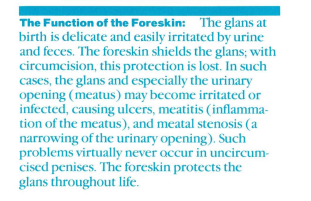
The AAP itself used to say as much. Its 1984 parent pamphlet, Care of the Uncircumcised Penis, stated that meatitis and meatal stenosis "virtually never occur" in intact boys, precisely because the foreskin protects the glans. Later editions quietly dropped that passage.
Put those numbers side by side. Preventing one infant UTI requires roughly 111 circumcisions, an absolute risk reduction under one percent. The risk of medically significant phimosis is smaller still. Meatal stenosis is substantially more common than either, yet it is rarely presented to parents as a circumcision risk. In an informal check of medical sites, most did not mention it on their circumcision pages at all; some discussed the connection only on separate meatal-stenosis pages, the kind of page a parent is more likely to find after it has already become a problem.
The usual explanation is that circumcision “risks” means surgical complications: bleeding, infection, or injury occurring during or shortly after the procedure. But timing alone cannot justify excluding meatal stenosis. UTI prevention is also a downstream effect, and phimosis may not occur until years later. Those delayed outcomes are still counted because they favor circumcision. Meatal stenosis is also delayed (and more common than either) but it gets excluded.
That is the real problem: the accounting is not simply separating immediate effects from delayed ones. It is allowing favorable delayed effects into the risk-benefit calculation while leaving an unfavorable one out. If one of the more common adverse outcomes is excluded before parents ever see the comparison, they are not being given the full evidence to weigh.
Bottom line
Either every downstream, non-immediate effect of circumcision counts toward the tally, or none of them do. Right now the rule seems to be: downstream effects count when they favor the surgery, and disappear into a definitional gap when they don't. They are seeing what happened to make the marketing cut.
Figures cited here, such as the 7–18% meatal stenosis range and the ~111 circumcisions needed to prevent one infant UTI, are sourced on the Care page. The 0.6% (1-in-167) pathological-phimosis figure is sourced on the Data, Visualized page, citing Shankar & Rickwood, 1999. Full citations are on both pages. This post is a personal argument about how that information tends to get framed, not a systematic audit of any specific hospital or organization's materials.